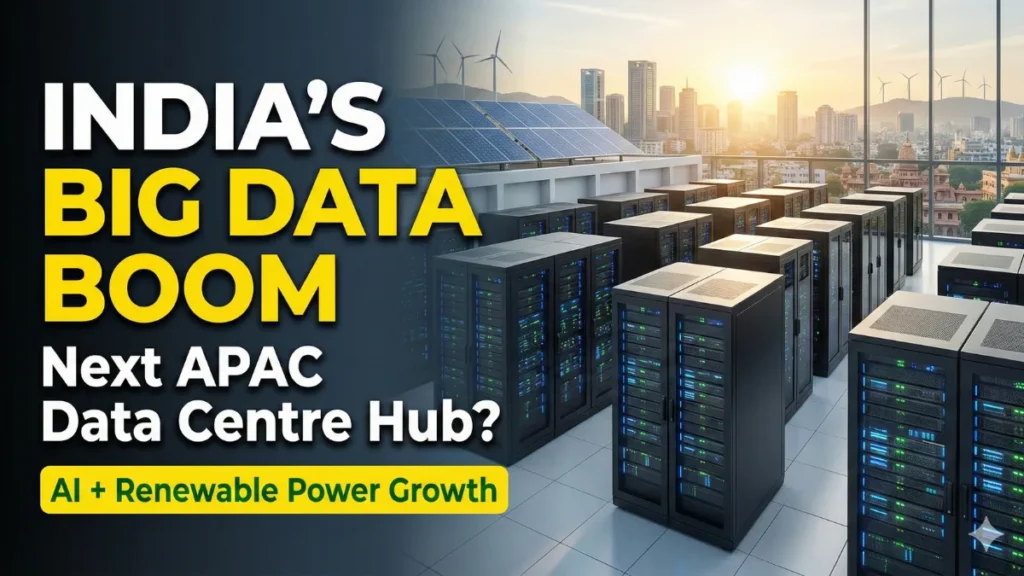
India stands at a defining moment in the global digital economy. According to a recent Deloitte report, the country has strong potential to evolve into a major APAC Data Centre Hub. However, this rise depends heavily on how effectively India aligns renewable energy growth with expanding digital infrastructure.
Currently, India accounts for nearly 20 percent of global data consumption. Yet, it hosts less than 5 percent of the world’s data centres. This gap clearly shows the scale of opportunity available.
As artificial intelligence adoption accelerates, data storage and computing needs continue to surge. Therefore, India’s ability to scale power infrastructure quickly will determine how much of the Asia Pacific market it captures.
Samsung Galaxy S26 Ultra: India Price, Jan 2026 Launch, New Camera Island, 5500mAh Battery
Why India Has Structural Advantages
India enjoys several built-in advantages that strengthen its position in the APAC Data Centre Hub landscape.
These include:
- Lower land acquisition costs
- Competitive construction expenses
- Relatively affordable power tariffs
- A large AI-skilled and technology workforce
Together, these factors create a rare structural opportunity. Investors view India as cost-effective compared to several global markets.
In addition, government policy support is improving. Budget 2026-27 proposes a tax holiday until 2047 for foreign companies that offer global cloud services from India. Preferential tax treatment for data centre investments further enhances attractiveness.
Because of these policy moves, India now competes strongly with other Asia Pacific nations seeking data centre capital.
Digital Access Grant 2025-Free Laptop and Home Broadband for Students
Massive Investment Wave Expected in Asia Pacific
The Asia Pacific region is projected to attract around $800 billion in data centre investments by 2030. As a result, the region’s share of global capacity could rise to nearly 40 percent.
This would make Asia Pacific the largest market outside North America.
Within this context, India is emerging as one of the strongest contenders. If infrastructure keeps pace, the country could capture a significant portion of this capital flow.
Data Centre Capacity to Expand Rapidly
India’s installed data centre capacity currently stands near 1.5 gigawatts in 2025. However, projections suggest this could expand to between 8 and 10 gigawatts by 2030.
This represents nearly a six-fold increase within five years.
Such rapid expansion will largely be driven by AI-led computing demand. Yet, AI-focused server racks consume 10 to 15 times more power than traditional racks.
Therefore, electricity demand will surge sharply.
Electricity Demand Surge
AI-driven data centre growth may require:
- 40 to 45 terawatt hours of additional power by 2030
- Compared to 10 to 15 terawatt hours in 2024
As a result, the sector’s share of national electricity consumption could rise from about 0.8 percent to between 2.5 and 3 percent.
This sharp jump presents both opportunity and risk.
Maruti Suzuki Brezza 2025-Mild Hybrid Compact SUV with 6 Airbags
Power and Grid Challenges Could Slow Growth
Although India benefits from relatively low electricity costs and a modern grid, supply expansion may not keep pace with demand.
If generation and transmission infrastructure fail to scale simultaneously, a supply gap could emerge.
Data centres require uninterrupted, high-quality power with minimal transmission losses. Even small disruptions can impact operations.
However, several challenges remain:
- Variations in renewable banking rules across states
- Differences in open access charges
- Cross-subsidy costs
- Tariff uncertainty
- Lack of a unified national renewable framework
Because policies differ from state to state, developers face uncertainty while planning long-term investments.
State-Level Demand Pressure
Major data centre hubs such as:
- Maharashtra
- Tamil Nadu
- Uttar Pradesh
- Karnataka
- Telangana
- Andhra Pradesh
could each witness an additional 2 to 3 gigawatts of peak demand by 2030.
In some states, this could equal 5 to 20 percent of current peak loads. Naturally, this would place serious pressure on state grids.
Transmission upgrades often take longer to build than renewable generation projects. Therefore, grid bottlenecks may slow expansion if not addressed quickly.
Renewable Energy Will Be the Deciding Factor
India’s long-term success as an APAC Data Centre Hub depends on renewable integration.
Deloitte recommends accelerating:
- Solar-wind hybrid models
- Energy storage deployment
- Long-term green power purchase agreements
- Group captive renewable structures
- Captive renewable installations
These measures can provide tariff certainty while reducing price volatility.
Moreover, combining renewable generation with storage ensures round-the-clock reliability for AI workloads.
New Honda City 2025: Premium Design, Hybrid Efficiency, and Feature-Rich Cabin
Dedicated Data Centre Economic Zones
The report also suggests creating power-ready Data Centre Economic Zones.
These zones would include:
- Pre-built substations
- Standardised grid connection timelines
- High-capacity transmission infrastructure
Such readiness would reduce delays and attract global operators.
Standardising renewable banking policies across states would further create predictability. Investors prefer stable regulatory environments when committing billions in capital.
Smarter Energy Management Through AI
Interestingly, AI itself can help manage power more efficiently.
Non-urgent computing tasks could be scheduled during periods of low-cost and high renewable availability. This would reduce stress on the grid and optimise clean energy use.
Decentralised renewable systems, including co-located solar and storage facilities near emerging data corridors, also offer strong potential.
By combining smart scheduling with clean energy generation, India can build sustainable AI infrastructure.
A Defining Moment for India’s Digital Future
India has a rare structural opportunity to rise as a global leader in sustainable digital infrastructure.
However, timing matters.
Power availability and transmission readiness must scale alongside digital ambition. Otherwise, growth could slow.
If policymakers align grid upgrades, renewable expansion, and investor-friendly frameworks, India can secure a central position in the global APAC Data Centre Hub ecosystem.
The next few years will determine whether India simply consumes data or becomes the region’s leading infrastructure backbone.
FAQs
India offers lower costs, skilled talent, policy incentives, and growing renewable capacity.
The region could attract around $800 billion in data centre investments.
Capacity may expand from about 1.5 GW in 2025 to 8–10 GW by 2030.
They may need 40–45 TWh of extra power by 2030.
Power supply gaps and grid infrastructure limitations remain the main risks

John Michael Ramos is a blogger passionate about Government Schemes, Exams, Automobiles, and Trending News. His aim is to provide simple and authentic information.