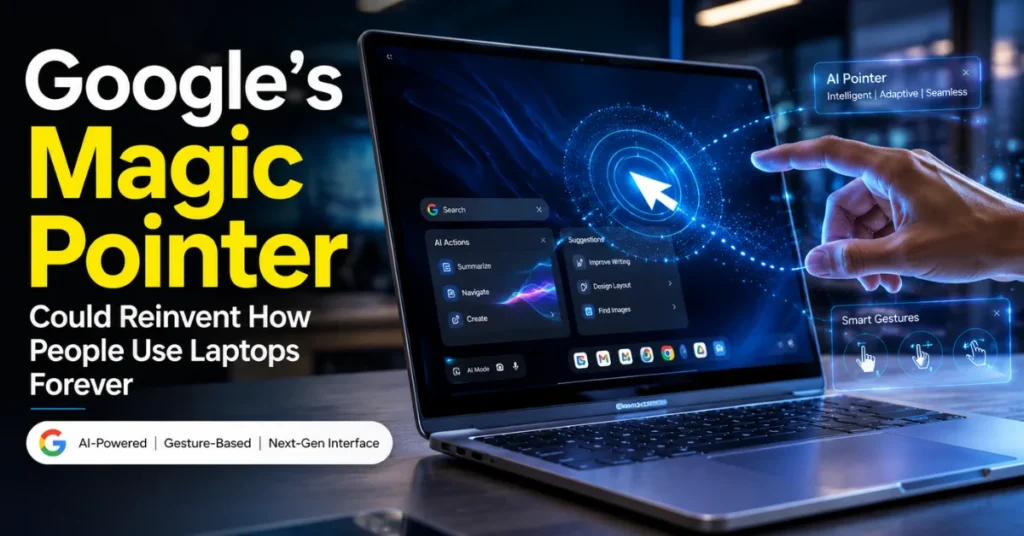
Google is preparing one of its most unusual AI-powered computer features yet. The company recently revealed new details about “Magic Pointer,” an intelligent cursor system designed for its upcoming Googlebooks laptops.
Unlike a traditional mouse pointer, Magic Pointer uses artificial intelligence to understand what users are looking at on screen. Google says the system can instantly analyze text, charts, images, spreadsheets, and webpages with simple cursor movements.
The feature will launch later this year alongside Googlebooks, Google’s new AI-focused laptop platform. Early demonstrations already suggest the technology could dramatically change how users interact with computers during everyday tasks.
Google Unveils Gemini Intelligence For Android With Powerful AI Features Across Devices
New Magic Pointer Adds AI Directly To The Cursor
Google describes the New Magic Pointer as a context-aware AI assistant built directly into the cursor itself. Instead of opening separate AI apps or chat windows, users can simply hover over content and request actions instantly.
For example, users can point at a PDF document and ask for a quick bullet-point summary. The system can then instantly generate text ready to paste into emails or notes.
Google also demonstrated spreadsheet controls powered entirely through cursor interaction.
In one example, a user hovered over two spreadsheet columns and simply said, “merge these.” The system automatically combined the data without requiring complicated commands.
The feature may help reduce the need for manually typing detailed prompts into AI assistants.
Google says Magic Pointer focuses heavily on faster workflows and more natural computer interaction.
Google Unveils Futuristic Googlebook Laptops Powered By Gemini AI
Googlebooks Could Become Google’s Biggest AI Hardware Push
The New Magic Pointer feature appears central to Google’s broader Googlebooks strategy. The company wants these laptops to behave differently from traditional Windows or Mac devices.
Instead of treating AI as a separate tool, Google wants artificial intelligence integrated directly into normal computer actions.
The system can reportedly transform tables into charts, summarize webpages, compare products, and even modify recipes instantly.
One demonstration showed a user highlighting a recipe and asking the AI to double all ingredient amounts automatically. Another demo converted a statistics table into a pie chart using only cursor actions.
Google also confirmed the cursor system works alongside Gemini AI inside Chrome.
Users may soon highlight multiple products on a shopping page and ask Gemini to compare pricing, features, or specifications automatically.
This approach could make AI interactions feel faster and more integrated into everyday browsing.
Google’s Gemini For Home Update Makes Smart Homes Faster, Smarter And More Personal
Google Wants AI To Feel More Invisible And Natural
Many current AI systems still require users to stop working and open separate chatbots or applications. Google appears determined to remove those extra steps entirely.
According to DeepMind, the goal behind Magic Pointer is to push AI beyond dedicated windows and make it feel naturally connected to everything happening on screen.
The company believes AI should quietly assist users in the background instead of interrupting workflows.
Interestingly, Google already offers an early version of the pointer technology inside Google AI Studio. Users can test image editing and map-related AI interactions before Googlebooks officially launches later this year.
Industry analysts believe this could become one of Google’s most important long-term AI projects. Rather than competing only through chatbots, the company now wants artificial intelligence deeply woven into the core computer experience.
If Magic Pointer performs smoothly in real-world usage, Googlebooks could introduce an entirely new way of controlling laptops and productivity software.
Google’s Smart Pixel Voicemail Feature Could Soon Arrive On More Android Phones

Anku is a Technology News writer covering Smartphones, AI, software, gaming, laptops, iOS updates, tech trends. He focuses on creating simple, informative, and reader-friendly news in Simple English Language.