Every Pinoy guitarist knows the struggle. You’ve memorized your basic open chords, you’re confidently strumming your favorite OPM tunes, and then suddenly, a wild F chord appears and ruins the harana. Learning how to play the F chord on guitar is widely considered the ultimate “end-level boss” for beginners. But do not let it discourage you; mastering it is entirely possible with the right technique, a little patience, and a few clever shortcuts.
Whether you want to jam to Eraserheads, Parokya ni Edgar, or Ben&Ben, this chord is unavoidable because it belongs to some of the most popular keys in music. Here is your ultimate guide to conquering it.
Read Also-Philippine Passport Power: New Global Rankings and Visa-Free Destinations for Filipino Travelers
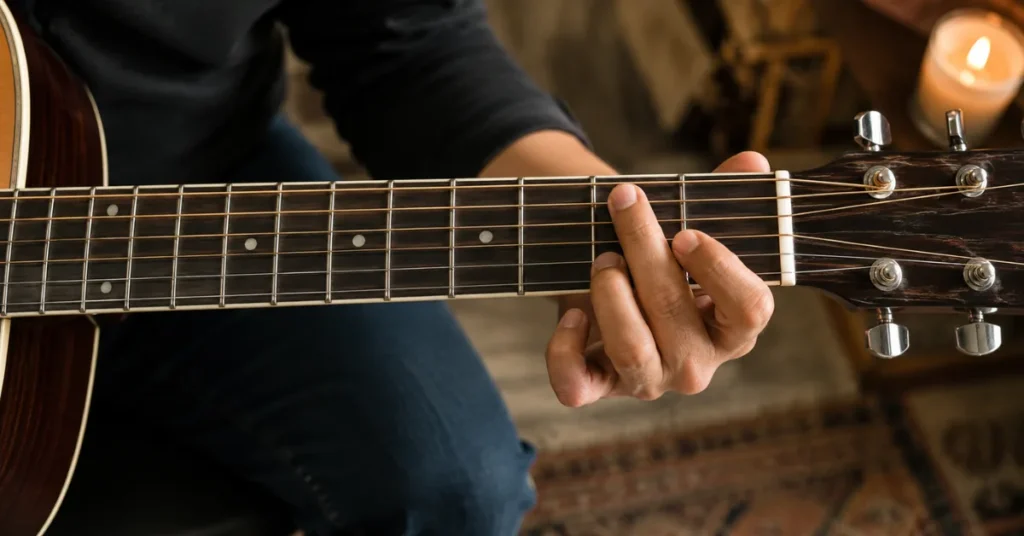
Why is the F Chord on Guitar So Hard to Play?
The standard F major is a barre chord, meaning your index finger has to act like a capo, pressing down multiple strings at once across a single fret. Because the F chord is located at the 1st fret where the string tension is at its highest and the strings are furthest from the fretboard—it requires significant finger strength and dexterity.
The full F barre chord consists of the notes F, A, and C. Here is how the standard shape is built:
- Index Finger: Barred completely across all six strings on the 1st fret.
- Middle Finger: Placed on the 2nd fret of the 3rd string (G string).
- Pinky Finger: Placed on the 3rd fret of the 4th string (D string).
- Ring Finger: Placed on the 3rd fret of the 5th string (A string).
If your hand feels like it’s cramping just reading that, do not worry. You are not alone!
Expert Tips to Conquer the Full Barre Shape
If you are determined to play the full barre chord, brute force is not the answer. Try these adjustments to make it ring out clearly:
- Roll Your Index Finger: Do not lay your index finger completely flat on its soft, fleshy side. Instead, roll it slightly to the side so the harder, bony part of your finger is pressing the strings.
- Focus on the Right Strings: Your middle, ring, and pinky fingers are already fretting the A, D, and G strings. This means your barring index finger only actually needs to press down firmly on the low E, B, and high E strings.
- Check Your Thumb: Position your thumb in the middle of the back of the guitar neck, creating a “clamp” with your index finger.
- Practice Higher Up the Neck: String tension is much lower around the 5th or 7th fret. Try practicing the exact same barre shape up there to build your finger independence before sliding it down to the dreaded 1st fret.
Read Also-BPI Free InstaPay Transfers: Everything You Need to Know About the July 2026 Update
Easy F Chord Alternatives (No Barre Needed!)
If you are playing a gig or hanging out with friends and need to play an F chord right now without the hand cramps, use these beginner-friendly variations.
1. The “Mini F” (Three-Finger Shape)
If you can play a standard C Major chord, you are already 90% of the way to playing this easy version.
- Place your index finger on the 1st fret of the 2nd string (B string).
- Place your middle finger on the 2nd fret of the 3rd string (G string).
- Place your ring finger on the 3rd fret of the 4th string (D string).
- Strumming Tip: Only strum the bottom four strings (D, G, B, e). Use your thumb or ring finger to gently touch and mute the thick E and A strings so they do not ring out.
2. The F Major 7 (Fmaj7)
This is a beautiful, dreamy alternative that sounds amazing in acoustic ballads.
- Use the exact same shape as the “Mini F” above, but leave the thinnest string (high E) completely open.
- The open E note adds a jazzy, warm flavor to the chord. Just be aware that while it sounds great, it might not perfectly fit the vibe of heavier rock songs.
How to Master the Chord Transition
Knowing the chord shape is useless if you cannot switch to it in time with the song. The most common transition in guitar music is moving from a C chord to an F chord.
Practice the “Common Chord Fingers” method:
- Form a standard open C Major chord.
- Notice how your index finger is already planted on the 1st fret of the B string. Keep it there! This is your anchor.
- Simply drop your middle and ring fingers down one string each to form the easy F shape.
- Practice switching back and forth between C and F very slowly, using a metronome, until muscle memory takes over.
Stay patient and keep practicing a few minutes every day. Soon enough, that stubborn chord will feel just as natural as a basic G or D.
Read Also- Government Service Insurance System Expands Loan Relief Program for State Workers