India has officially started preparations for Census 2027 with the launch of a nationwide digital self-enumeration system. For the first time in the country’s history, citizens can now submit household details online before government enumerators begin physical verification visits.
The move marks a historic transformation in India’s census operations. Officials describe Census 2027 as the country’s first fully digital census exercise and one of the largest technology-driven administrative projects ever attempted.
The new system allows residents to independently complete census forms through a secure online platform. Authorities believe the digital model will improve participation, reduce paperwork, increase data accuracy, and speed up nationwide processing.
The census will continue under the Census Act of 1948, while the Ministry of Home Affairs and the Office of the Registrar General of India oversee operations.
RCB vs PBKS IPL 2026 Points Table: RCB Move Closer To Playoffs As Punjab Face Huge Pressure
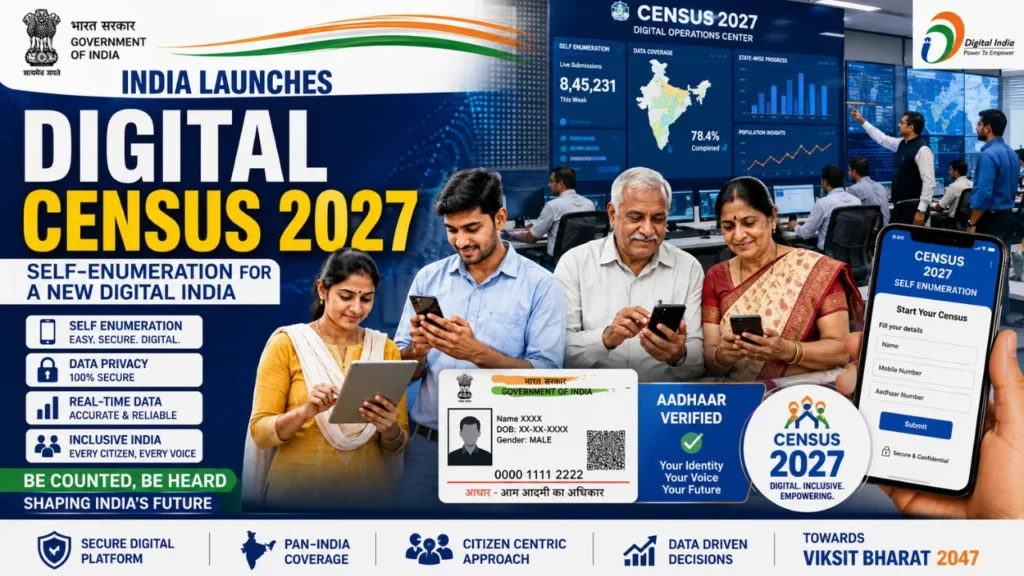
India Launches Digital Self-Enumeration Across Multiple States
The government has already opened self-enumeration windows in several states and Union Territories. Delhi, Maharashtra, Rajasthan, Jharkhand, and Meghalaya began registrations earlier this month. Uttar Pradesh and Gujarat also activated the digital process for residents.
Authorities confirmed the online self-enumeration period generally remains open for 15 days before house listing operations begin physically.
Residents who complete the process online receive a unique 11-digit Self-Enumeration ID. Officials later verify this ID during door-to-door visits conducted by field enumerators.
The government also clarified that households unable to complete the digital process will still receive physical visits. Officials say no citizen will be excluded because of internet access limitations or technical problems.
The digital census initiative arrives after years of delays surrounding India’s national population survey. Officials now believe technology will help streamline operations across the country’s massive and diverse population.
Delhi Petrol And Diesel Prices Surge Again As Public Reacts With Anger
How The Digital Census System Works
The self-enumeration process has been designed to function like a guided digital workflow. Officials estimate most households can complete the process within 15 to 20 minutes.
Users first select their state or Union Territory before registering household details.
Residents must provide the head of household name and verify a mobile number through a one-time password system. The portal then asks users to enter address details, district information, village or locality names, and nearby landmarks.
One of the biggest technology upgrades involves digital map verification. Users must place a red marker on an online map to identify the precise location of their residence.
The system then presents the official housing census questionnaire used by government enumerators.
Residents may save draft responses before final submission. However, once users press “Final Submit,” the information becomes locked and cannot be edited without official verification.
After submission, the portal automatically generates an 11-digit Self-Enumeration ID beginning with the letter “H.” Authorities advise residents to save the ID for future reference.
Golden Knights Push Ducks To The Brink After Massive Game 6 Playoff Battle
Census 2027 Will Include Major Technology And Caste Data Changes
Census 2027 introduces several major changes beyond online registration.
The government confirmed the operation will use GPS mapping systems, mobile applications, satellite imagery tools, and cloud-based monitoring dashboards.
Officials created four separate digital platforms to manage the operation nationwide. These systems support real-time monitoring, field data collection, household verification, and geographic mapping.
Another major development involves caste enumeration.
Officials confirmed Census 2027 will include nationwide caste-related questions during the population enumeration phase. This becomes the first large-scale caste enumeration exercise since 1931 that extends beyond Scheduled Castes and Scheduled Tribes.
The government says updated demographic data will support urban planning, welfare schemes, healthcare expansion, education planning, migration analysis, and future delimitation exercises.
Authorities also stressed that all census information remains confidential under Section 15 of the Census Act. Officials stated the collected data cannot be disclosed publicly or shared through RTI requests or court proceedings.
Despite the technological push, challenges remain.
Experts continue raising concerns about digital literacy gaps, internet connectivity in rural regions, and the political sensitivity surrounding caste data collection. However, the government insists physical enumerator visits will ensure complete nationwide coverage.
With Census 2027 now entering its first operational stage, India appears ready to modernize one of the world’s largest population data exercises through large-scale digital infrastructure.
How to Turn Off Instagram New Instants Feature Before It Shares Your Photos Automatically