Amazon has spent years automating its fulfillment centers, but its latest robot represents a significant step forward.
The company has unveiled an upgraded version of Proteus, its warehouse robot platform, that can now understand and respond to natural language instructions from employees. Instead of relying on specialized software commands, workers can simply tell the robot what needs to be done, and the system figures out how to complete the task.
The announcement highlights how artificial intelligence is rapidly moving beyond chatbots and into real-world industrial environments.
Amazon AI Leaderboard Shut Down After Rising AI Usage Drives Higher Costs
Amazon Proteus Robot Gains A Major AI Upgrade
Amazon currently operates more than one million robots across its warehouse network. However, previous robotic systems typically required predefined instructions and specialized software to perform tasks.
The new Amazon Proteus Robot changes that approach.
According to Amazon Robotics Vice President Scott Dresser, workers can now communicate with the robot using everyday language. Employees simply describe what needs to happen, while the AI determines priorities, routes, timing, and execution.
That shift may sound simple, but it fundamentally changes how humans interact with warehouse automation.
Why The Amazon Proteus Robot Matters
Most warehouse robots operate within tightly controlled environments.
They follow programmed routes, perform repetitive tasks, and often require human supervisors to configure workflows. The upgraded Proteus platform introduces more flexibility by allowing workers to interact with robots much more naturally.
As a result, warehouses may become easier to manage while reducing the need for specialized robotics training.
For employees, that could mean spending less time operating software and more time focusing on higher-value tasks.
What The New Proteus Robot Can Do
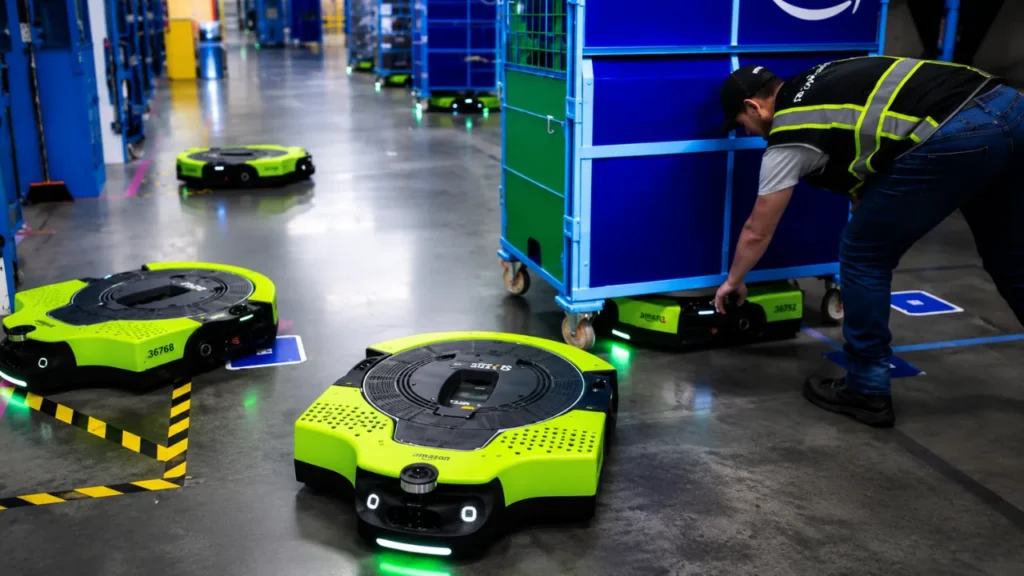
Proteus resembles a heavy-duty robotic platform designed to transport carts and containers across large fulfillment centers. While earlier versions operated primarily in dock areas, the upgraded system can work throughout much larger sections of a warehouse.
Amazon Globalstar Acquisition Could Challenge Starlink With Next-Generation Satellite Phone Services
Amazon Proteus Robot Capabilities
| Feature | Function |
| Natural Language Commands | Understands conversational instructions |
| Autonomous Navigation | Determines routes automatically |
| Cart Transportation | Moves heavy containers |
| Warehouse Mobility | Operates across fulfillment centers |
| AI Task Planning | Prioritizes jobs independently |
| Employee Assistance | Supports warehouse workflows |
The robot can transport incoming containers, move inventory between workstations, and assist employees with logistics operations throughout a facility.
Amazon Wants Humans And Robots Working Together
One of the most interesting aspects of the announcement is Amazon’s emphasis on collaboration rather than replacement.
The company says the upgraded robots will allow employees to focus on higher-skilled responsibilities such as inventory management, quality control, and workflow oversight. Additionally, Amazon argues that robotic automation helps reduce repetitive work while improving workplace safety.
This messaging is important because concerns about automation replacing jobs continue to grow across multiple industries.
Amazon maintains that robotics has expanded alongside its workforce rather than eliminating the need for human workers. The company also says it plans to add approximately 25,000 warehouse jobs in Europe over the coming years.
The Bigger Picture For AI-Powered Robotics
The upgraded Amazon Proteus Robot reflects a larger trend across the technology industry.
Artificial intelligence is increasingly becoming the interface between people and machines.
Instead of learning complicated software systems, workers can interact with technology using natural conversation. Similar trends are emerging in enterprise software, consumer AI assistants, and autonomous systems.
Consequently, the future of robotics may depend less on hardware improvements and more on making machines easier for people to understand and control.
Amazon’s Automation Efforts Continue To Expand
Proteus is only one part of Amazon’s broader robotics strategy.
The company is also developing Vulcan, a touch-sensitive robot designed to handle inventory more effectively, and Stark, a new robotic system focused on moving smaller containers known as totes.
Together, these projects demonstrate Amazon’s long-term commitment to AI-driven warehouse automation.
However, the company is still testing the upgraded Proteus system in its laboratories. Amazon expects to begin deploying the technology in European facilities during the first half of 2027.
The Price of Nvidia RTX Spark PC Is About To Shock Early AI Adopters
Why Consumers Should Care
Most shoppers will never see a Proteus robot in person.
Yet technologies like this directly affect how products move through Amazon’s supply chain.
More efficient warehouse operations can improve delivery speed, reduce logistical bottlenecks, and potentially lower operating costs. Over time, those improvements could influence everything from shipping times to inventory availability.
Therefore, warehouse robotics may have a larger impact on consumers than many people realize.
Final Thoughts
The new Amazon Proteus Robot isn’t just another warehouse machine.
It represents a shift toward a future where employees communicate with robots the same way they communicate with coworkers. By combining autonomous navigation with conversational AI, Amazon is making warehouse automation more flexible, accessible, and potentially more productive.
Whether that approach transforms the industry remains to be seen. However, the latest Proteus upgrade offers a glimpse of how AI could reshape workplace technology far beyond the warehouse floor.
FAQs
Proteus is Amazon’s autonomous warehouse robot designed to transport carts and inventory throughout fulfillment centers.
The upgraded version can understand natural language instructions and independently plan routes and tasks.
Yes. Amazon says workers can assign tasks using plain conversational language.
Amazon plans to begin using them in Europe during the first half of 2027.
Amazon says the robots are intended to assist employees and allow them to focus on higher-skilled work