Quick Summary
- Microsoft has launched ASSERT, an open-source framework designed to test how AI systems behave in real-world business scenarios.
- The tool can convert simple text descriptions into structured AI evaluation tests.
- Developers can use ASSERT to identify policy violations, reliability issues, and unexpected AI behavior before deployment.
- The launch reflects a growing industry shift from building AI models to ensuring those models behave as intended.
Microsoft AI Behavior Testing Tool Brings A New Approach To AI Evaluation
As artificial intelligence becomes more capable, a new challenge is emerging for businesses: making sure AI systems actually behave the way they’re supposed to.
That’s where Microsoft’s new Microsoft AI Behavior Testing Tool comes in.
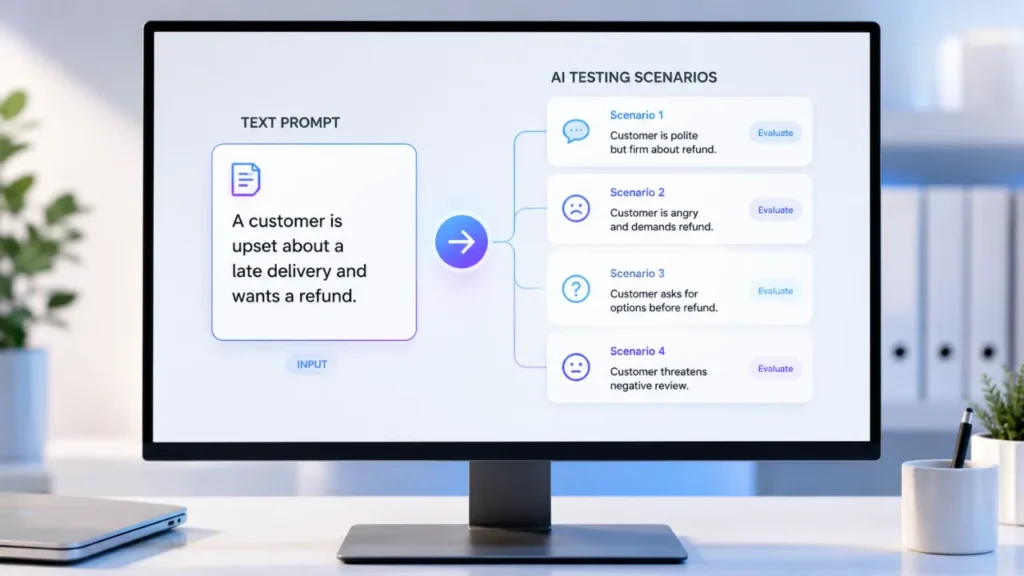
The company has introduced ASSERT, short for Adaptive Spec-driven Scoring for Evaluation and Regression Testing, an open-source framework designed to help developers test AI behavior using plain-language instructions. Instead of manually creating hundreds of evaluation scenarios, developers can simply describe how an AI system should behave, and ASSERT generates structured tests automatically.
While AI companies often focus on model intelligence, Microsoft is focusing on something equally important: trustworthiness.
Microsoft Unveils New AI Models To Cut Costs And Reduce Dependence On OpenAI
Why The Microsoft AI Behavior Testing Tool Matters
Most AI benchmarks measure general capabilities such as reasoning, coding, or knowledge.
However, businesses face a different problem.
A customer-service chatbot, legal assistant, healthcare tool, or enterprise AI agent must follow specific rules that are unique to that organization. Traditional benchmarks often fail to capture those requirements.
The new Microsoft AI Behavior Testing Tool aims to fill that gap by allowing organizations to evaluate AI systems against their own policies, workflows, and operational constraints.
For example, a company may want an AI assistant to:
- Avoid sharing confidential information
- Follow industry compliance rules
- Limit access to sensitive data
- Respect company communication policies
- Handle customer interactions consistently
Rather than creating these tests manually, ASSERT can generate them automatically from text descriptions.
How Microsoft’s ASSERT Framework Works
The process is surprisingly straightforward.
Developers provide natural-language instructions describing how an AI system should behave.
ASSERT then transforms those instructions into structured evaluation criteria.
ASSERT Workflow
| Step | Function |
| Define Behavior | Developer describes expected AI behavior |
| Generate Rules | ASSERT creates acceptable and unacceptable actions |
| Build Test Cases | System generates evaluation scenarios |
| Run Evaluations | AI model is tested automatically |
| Score Results | Performance is measured and analyzed |
| Investigate Failures | Developers review problematic behavior |
Additionally, the framework records intermediate actions and tool calls, allowing teams to understand exactly where an AI system failed.
That visibility can be especially valuable when debugging complex AI agents.
Microsoft Threatens Legal Action Against Security Researcher Over Unpatched Windows Bugs
Microsoft AI Behavior Testing Tool Targets A Growing Enterprise Need
The timing of the launch is notable.
Over the past two years, companies have rapidly deployed AI assistants, copilots, and autonomous agents. As a result, concerns have shifted from “Can AI do this?” to “Can AI do this reliably?”
The new Microsoft AI Behavior Testing Tool reflects that transition.
According to Microsoft, broader AI evaluations often fail when organizations need application-specific behavior testing. A model might perform well on public benchmarks while still violating company policies in production environments.
Consequently, businesses are increasingly investing in evaluation frameworks that focus on practical deployment rather than theoretical performance.
A Real-World Example Of ASSERT In Action
Microsoft provided an example involving a document research AI agent.
Suppose a company wants its AI assistant to:
- Avoid emailing external contacts
- Restrict confidential information to executives
- Provide concise summaries
- Consider previous context when generating responses
Instead of manually building dozens of tests, developers can describe those requirements in plain language.
ASSERT then creates scenarios designed to determine whether the AI consistently follows those rules.
This approach dramatically reduces the time required to evaluate complex AI systems.
The Bigger Shift Happening Across The AI Industry
The launch of ASSERT highlights a broader trend.
For much of the AI boom, the industry’s focus centered on building larger and more capable models. Now, attention is increasingly shifting toward evaluation, governance, and reliability.
Organizations such as Stanford’s HELM, MLCommons’ AILuminate, and research groups like METR have all expanded efforts to measure how AI behaves under different conditions.
Microsoft’s latest framework fits directly into that movement.
Rather than asking whether an AI model is powerful, companies are beginning to ask whether it is predictable, compliant, and trustworthy.
That distinction may become one of the defining challenges of the next phase of AI adoption.
Alphabet AI Infrastructure Spending 2026 Hits $80 Billion As Google Doubles Down On AI Future
What This Means For Developers
For developers, ASSERT could simplify one of the most time-consuming parts of AI deployment.
Potential benefits include:
- Faster AI testing
- Better policy compliance
- Easier debugging
- Continuous monitoring capabilities
- Reduced deployment risks
- More reliable AI agents
Furthermore, because the framework is open source, organizations can customize it for their own environments and workflows.
That flexibility could help accelerate adoption among enterprise customers.
Final Thoughts
The new Microsoft AI Behavior Testing Tool may not attract the same attention as a breakthrough AI model, but it addresses a problem that businesses increasingly care about.
As AI systems gain more autonomy, reliability becomes just as important as intelligence. Microsoft’s ASSERT framework recognizes that reality by helping developers verify whether AI behaves according to specific business requirements.
In many ways, this launch signals where the AI industry is heading next. Building smarter models remains important, but ensuring those models behave responsibly and consistently may prove even more valuable in the long run.
FAQs
Microsoft has introduced ASSERT, an open-source framework for evaluating AI behavior using natural-language descriptions.
ASSERT stands for Adaptive Spec-driven Scoring for Evaluation and Regression Testing.
It converts plain-language behavior requirements into structured evaluation tests and scores AI systems against those criteria.
Developers, enterprises, and organizations building AI applications can use the framework to test AI behavior.
It helps ensure AI systems follow company policies, remain compliant, and behave reliably in real-world environments.