For years, technology companies have tried to make wearables the next major computing platform. Smartwatches succeeded, while products like Google Glass and Microsoft’s own HoloLens struggled to gain mainstream adoption.
Now Microsoft is trying something different.
The company recently revealed a pair of experimental AI-powered devices, including a wearable badge designed specifically for office workers who regularly interact with AI agents. While still in the prototype stage, the project offers a glimpse into how Microsoft believes employees may work alongside artificial intelligence in the future.
More importantly, it shows that Microsoft’s AI ambitions extend far beyond software.
Microsoft Project Solara OS Could Replace Apps With AI Agents-At Least That’s Microsoft’s Vision
Microsoft Testing Wearable AI Gadget As Part Of A Larger AI Vision
The wearable device appeared during Microsoft’s Build 2026 developer conference as part of the company’s broader Project Solara initiative.
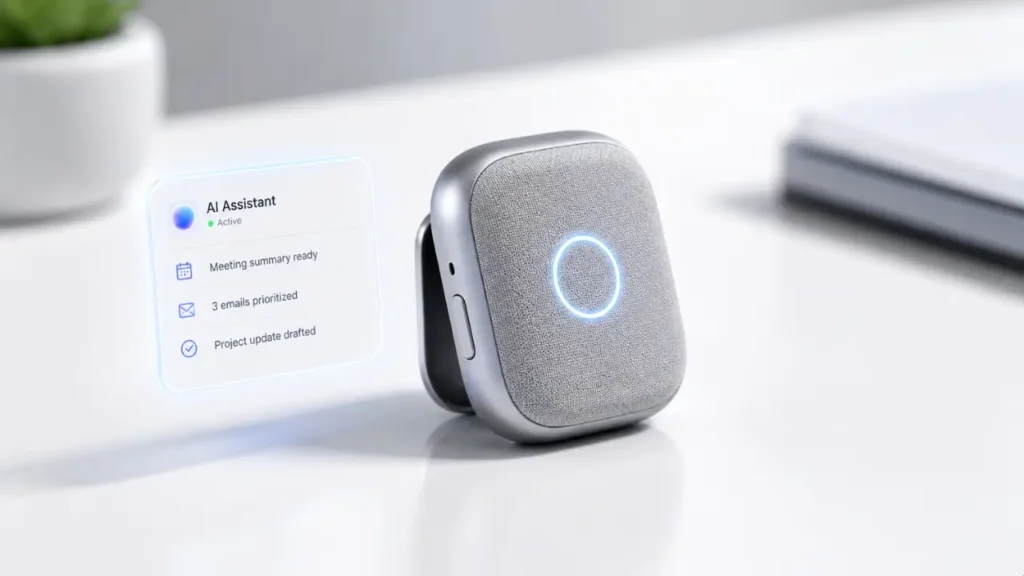
Unlike a smartwatch or smart glasses, the device resembles an office access badge that can be worn around the neck or attached to a belt loop. Microsoft says the wearable is designed to provide quick access to AI-powered workplace tools without requiring users to constantly reach for a laptop or smartphone.
Alongside the badge, Microsoft also demonstrated a desktop AI device featuring a touch- and voice-enabled display. Together, the products represent Microsoft’s vision for AI-native hardware built specifically around workplace productivity.
Why Microsoft Testing Wearable AI Gadget Matters
Most AI interactions today still happen through apps, websites, or chat interfaces.
Microsoft appears to believe that model may not be ideal in the long run.
Instead, the company is exploring hardware that allows users to interact with AI agents continuously throughout the workday. These agents can help manage tasks, coordinate workflows, retrieve information, and assist with productivity-related activities.
As AI becomes more integrated into professional environments, reducing friction between users and AI systems could become increasingly important.
That is where wearable devices may have an advantage.
Rather than opening applications and typing prompts, workers could access AI assistance instantly through dedicated hardware.
What Microsoft’s AI Wearable Can Do
Although Microsoft has not revealed complete technical specifications, demonstrations highlighted several key capabilities.
Microsoft AI Wearable Highlights
| Feature | Details |
| Form Factor | Wearable access badge |
| Authentication | Fingerprint activation |
| Camera | Built-in camera support |
| AI Integration | Connects to AI agents |
| Workplace Focus | Office productivity |
| Connectivity | Works with Microsoft software and PCs |
During one demonstration, Microsoft executive Steven Bathiche activated the badge using a fingerprint, pointed the device toward the audience, and instructed it to capture photos and send them for review. The system reportedly completed the task through connected AI agents.
The demonstration showcased how AI could move beyond answering questions and begin taking actions on behalf of users.
MAI-Thinking-1 Reasoning Model Signals Microsoft’s Biggest AI Ambition Yet
Microsoft’s AI Agents Are The Real Story
The hardware itself may not be the most important part of the announcement.
Instead, the wearable exists to support Microsoft’s growing ecosystem of AI agents.
According to the company, the badge and desktop device connect directly to Microsoft software and allow users to interact with AI agents outside traditional computers. These agents can perform tasks autonomously and help workers manage information more efficiently.
Consequently, the wearable acts as a gateway rather than a standalone product.
Microsoft’s broader strategy appears focused on creating an environment where AI remains constantly accessible throughout the workday.
Privacy Questions Could Follow The Device
As with many AI-powered wearables, privacy may become one of the biggest concerns.
The badge includes a camera designed to help AI agents better understand a user’s surroundings and provide context-aware assistance. Microsoft says the camera allows agents to take actions based on the environment around them.
However, wearable cameras have faced criticism before.
Products such as Meta’s AI glasses and the original Google Glass sparked debates about recording, surveillance, and data collection. Similar questions are likely to follow Microsoft’s wearable if it eventually reaches the market.
Therefore, privacy protections could become just as important as AI capabilities.
Microsoft Has Tried Wearables Before
This is not Microsoft’s first attempt to create a new hardware category.
The company previously spent years developing HoloLens, an augmented reality headset that initially attracted significant interest from businesses and government organizations. Microsoft even secured a multibillion-dollar military contract tied to the technology.
However, after years of development challenges and testing issues, Microsoft ended HoloLens production in 2024.
That history makes the company’s latest wearable project particularly interesting.
Rather than targeting immersive mixed reality, Microsoft is now focusing on lightweight AI-first hardware designed for everyday work environments.
Microsoft AI Behavior Testing Tool Could Solve One Of The Biggest Problems In Enterprise AI
When Could The Device Launch?
Microsoft has not announced a commercial release date.
The company says only a few hundred employees currently use the prototype devices internally, and the ongoing pilot program will help determine how future versions should be developed.
As a result, consumers and businesses should view the wearable as an experiment rather than an upcoming product launch.
Still, Microsoft’s willingness to publicly showcase the hardware suggests the company sees long-term potential in the category.
Final Thoughts
The fact that Microsoft Testing Wearable AI Gadget is noteworthy because it reflects a larger shift happening across the technology industry.
Companies are no longer asking whether AI belongs in the workplace. Instead, they are exploring how employees can interact with AI more naturally throughout the day.
Microsoft’s wearable badge may never become a commercial product in its current form. However, the underlying idea—a dedicated AI companion that remains available wherever you work could influence the next generation of productivity hardware.
Whether workers embrace that vision remains to be seen, but Microsoft clearly believes the future of AI extends well beyond the laptop screen.
FAQs
It is a prototype wearable badge designed to provide quick access to AI agents and workplace productivity tools.
No. Microsoft says the hardware is currently part of an internal pilot program.
The device can authenticate users, capture images, connect to AI agents, and interact with Microsoft software.
Yes. Microsoft equipped the badge with a built-in camera to provide environmental context for AI agents.
Yes. Microsoft demonstrated the device as part of its broader Project Solara AI initiative.