The highest court in the United States has recently commanded the nation’s undivided attention, sparking widespread conversations from coast to coast. As monumental decisions regarding immigration and deportation reshape federal policy, public interest in the corte suprema has reached extraordinary heights.
Whether you are tracking the latest legal developments or simply planning a visit to the nation’s capital, understanding both the immense power of this judicial body and the history of its iconic headquarters provides crucial insight into how American law actually works.
Read Also-Severe Thunderstorm Watch Issued as Extreme Heat Wave Batters the United States
Breaking Down the Latest Immigration Decisions
The Supreme Court is currently navigating one of its most consequential sessions in recent memory. A major focal point for the justices has been the intense legal battle surrounding immigration enforcement and deportation policies. The court recently handed down a sweeping 6-3 conservative-majority ruling that officially permits the administration to terminate Temporary Protected Status (TPS) for hundreds of thousands of immigrants, primarily affecting Haitian and Syrian nationals.
This ruling effectively closed the door on lower court interventions, granting the executive branch broad authority over humanitarian protections. As a direct result, affected individuals face an incredibly difficult choice: secure alternative permanent legal status or face the reality of deportation.
Because these high-stakes decisions directly impact millions of families and the broader American workforce, the court remains the absolute center of national political debates. The finality of these judgments highlights why the court is often viewed not just as a legal referee, but as a powerful architect of daily American life.
Inside the Edificio de la Corte Suprema
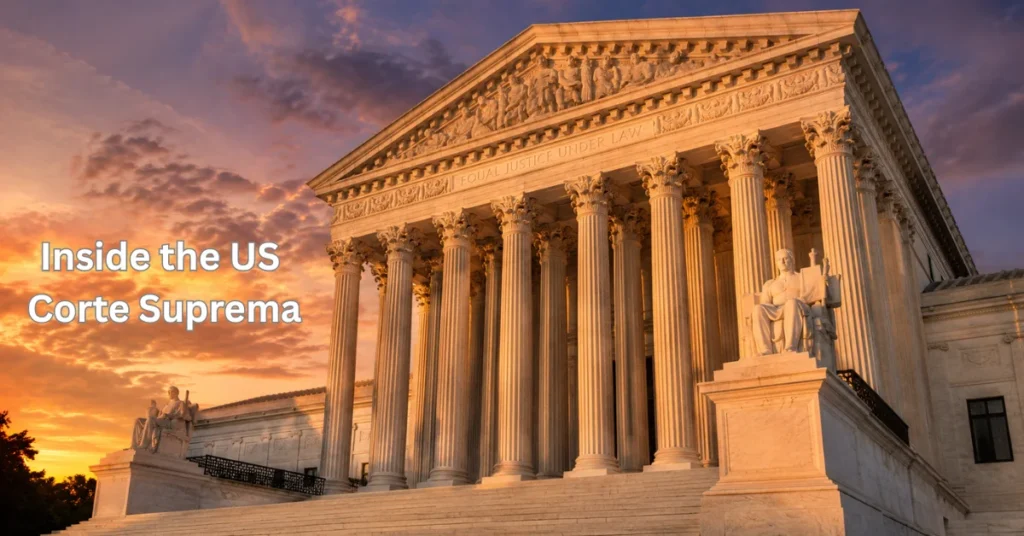
With the court making daily headlines, curiosity surrounding its physical location the famous edificio de la corte suprema de los estados unidos has surged. Located directly across from the US Capitol in Washington, D.C., this stunning structure is much more than just a government office; it is a meticulously designed temple of justice.
Surprisingly, the Supreme Court did not have its own dedicated building for the first 145 years of its existence. It wasn’t until 1929 that Chief Justice William Howard Taft successfully lobbied for a separate headquarters to physically represent the judicial branch’s independence from Congress. Designed by renowned architect Cass Gilbert, the Neoclassical masterpiece officially opened its doors in 1935.
Read Also-Venezuela Earthquakes Soccer Player Tragedy: Lucas Trejo Loses Family in Coastal Disaster
When visiting the iconic building, guests are immediately greeted by the breathtaking west facade. It features 26 massive marble columns and the famous phrase “Equal Justice Under Law” engraved above the entrance. The building itself is functionally divided into multiple levels:
- The Ground Floor: Houses the public information office, exhibition halls, a cafeteria, and the official gift shop.
- The First Floor: The true heart of the building, featuring the Great Hall, the majestic Courtroom where oral arguments are heard, and the private chambers for the justices.
- The Second and Third Floors: Dedicated to the justices’ dining rooms, vast legal libraries, and offices for the critical law clerks who assist in drafting opinions.
- The Fourth Floor: Contains a private gymnasium for court staff, which famously includes a basketball court jokingly referred to as “the highest court in the land.”
Can You Visit the Supreme Court?
For those traveling to Washington, D.C., the Supreme Court building remains a must-see landmark. It stands as a powerful symbol of the American judicial system. While the building is open to the public during standard weekday hours, access to the actual Courtroom is limited, especially on days when the justices are actively hearing oral arguments or handing down major decisions.
Visitors can explore the ground floor exhibits, take guided tours of the public areas, and view the magnificent architecture that houses the ultimate legal authority in the country. Given the recent string of historic rulings, standing on the marble steps of the court offers a unique connection to the ongoing, ever-evolving story of American law.
Read Also- Scoring a Discounted Hotel: Las Vegas, Extended Stays & More
Frequently Asked Questions (FAQs)
The court issued a ruling allowing the federal government to end Temporary Protected Status (TPS) for hundreds of thousands of immigrants, giving the executive branch the authority to proceed with deportations for those who cannot find alternative legal status.
The building is located at 1 First Street Northeast in Washington, D.C., directly across from the United States Capitol building.
The magnificent Neoclassical structure was designed by celebrated American architect Cass Gilbert and officially opened in 1935.
Yes, portions of the building, including exhibition halls and the cafeteria on the ground floor, are open to the public. However, access to the main Courtroom is restricted during active sessions.
The famous words “Equal Justice Under Law” are deeply engraved directly above the towering marble columns on the building’s west facade