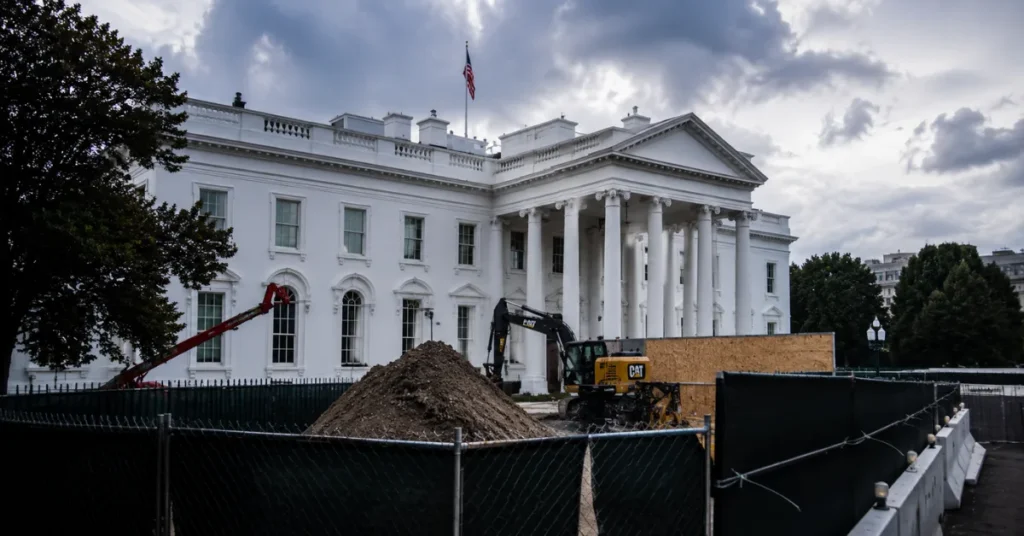
A massive renovation project at the White House is currently facing intense public and political scrutiny. Recent investigations have uncovered unusual financial arrangements surrounding the construction of a highly anticipated new pavilion. At the center of the controversy is a staggering $500 million agreement that bypassed traditional federal oversight.
For those following the latest developments in Washington, the details surrounding the east wing ballroom executive residence contract highlight a complex web of taxpayer money, anonymous private donors, and rising construction costs. Here is a breakdown of how the deal was structured and why it is generating so much debate.
Read Also-Inside the US Corte Suprema: Historic Immigration Rulings and the Temple of Justice
The $500 Million No-Bid Revelation
A recent report from The Washington Post revealed that the administration awarded a lucrative, no-bid contract to Virginia-based Clark Construction to fully demolish and rebuild the East Wing and East Colonnade. Typically, a federal infrastructure project of this immense size and complexity requires a competitive bidding process to ensure taxpayers get the best possible price.
However, officials managed to sidestep these standard cost-control measures by routing the agreement directly through the Executive Residence. This specific division of the Executive Office of the President is historically responsible for the day-to-day domestic operations, routine maintenance, and entertainment at the mansion. Crucially, the Executive Residence operates outside the standard federal rules that require agencies to solicit competing offers and publicly disclose their spending.
By classifying the massive demolition and construction project as an “improvement” under the purview of the Executive Residence, the administration was able to legally award the $500 million job to its preferred contractor without exposing the project to outside competition.
Ballooning Costs and Presidential Involvement
When the East Wing modernization was first announced last July, internal estimates valued the work at roughly $200 million. Since then, the price tag has skyrocketed, with internal projections now ballooning to a massive $600 million.
The renovation plans are incredibly ambitious. In addition to a grand new state ballroom, the blueprints call for a movie theater, upgraded kitchen facilities, vast new office spaces, and a secure underground bunker designed to house sensitive military and medical infrastructure.
President Donald Trump has reportedly taken a hands-on approach to the development. Records indicate he personally engaged in negotiations with contractors, including a March meeting where he successfully haggled the price of concrete down by $2.3 million from an initial $47 million quote. Despite the President’s previous public claims that wealthy private donors would cover the entirety of the project, experts now estimate that American taxpayers will be on the hook for roughly half of the final bill, primarily to cover the below-ground security upgrades.
Read Also-Venezuela Earthquakes Soccer Player Tragedy: Lucas Trejo Loses Family in Coastal Disaster
The Private Funding Loophole
The financing of the project relies on a highly unusual public-private partnership. A separate agreement finalized in October 2025 between the White House, the National Park Service, and the nonprofit Trust for the National Mall outlined how private money would be collected for the above-ground aesthetic work.
This contract empowers the Trust to collect hundreds of millions in private donations and funnel the money to the project. Most notably, the agreement legally ensures that the anonymity and privacy of the donors will be strictly preserved. This lack of transparency has alarmed ethics watchdogs, as it allows massive corporations and wealthy individuals many of whom may have active business interests with the federal government to secretly fund the President’s marquee architectural project.
Frequently Asked Questions (FAQs)
The administration routed the construction agreement through the Executive Residence, a specific office that is legally exempt from standard federal regulations requiring competitive bids and public spending disclosures.
While initial estimates sat around $200 million, the projected cost of the massive modernization project has since tripled to approximately $600 million.
The financing is a mix of private and public money. Private donors are funding portions of the aesthetic and above-ground work, while taxpayers are expected to cover roughly half of the total bill, primarily for secure underground military and medical infrastructure.
Virginia-based Clark Construction was awarded the no-bid contract to demolish the existing structure and build the new facility.
No. The fundraising agreement explicitly guarantees anonymity for the donors, meaning corporations and individuals can contribute millions to the project without their identities being revealed to the public
Read Also- Supreme Court Ends TPS for Haitians: Inside the Historic 2026 Ruling